AI Agents Aren’t Magic: They’re Computer Architecture Reapplied
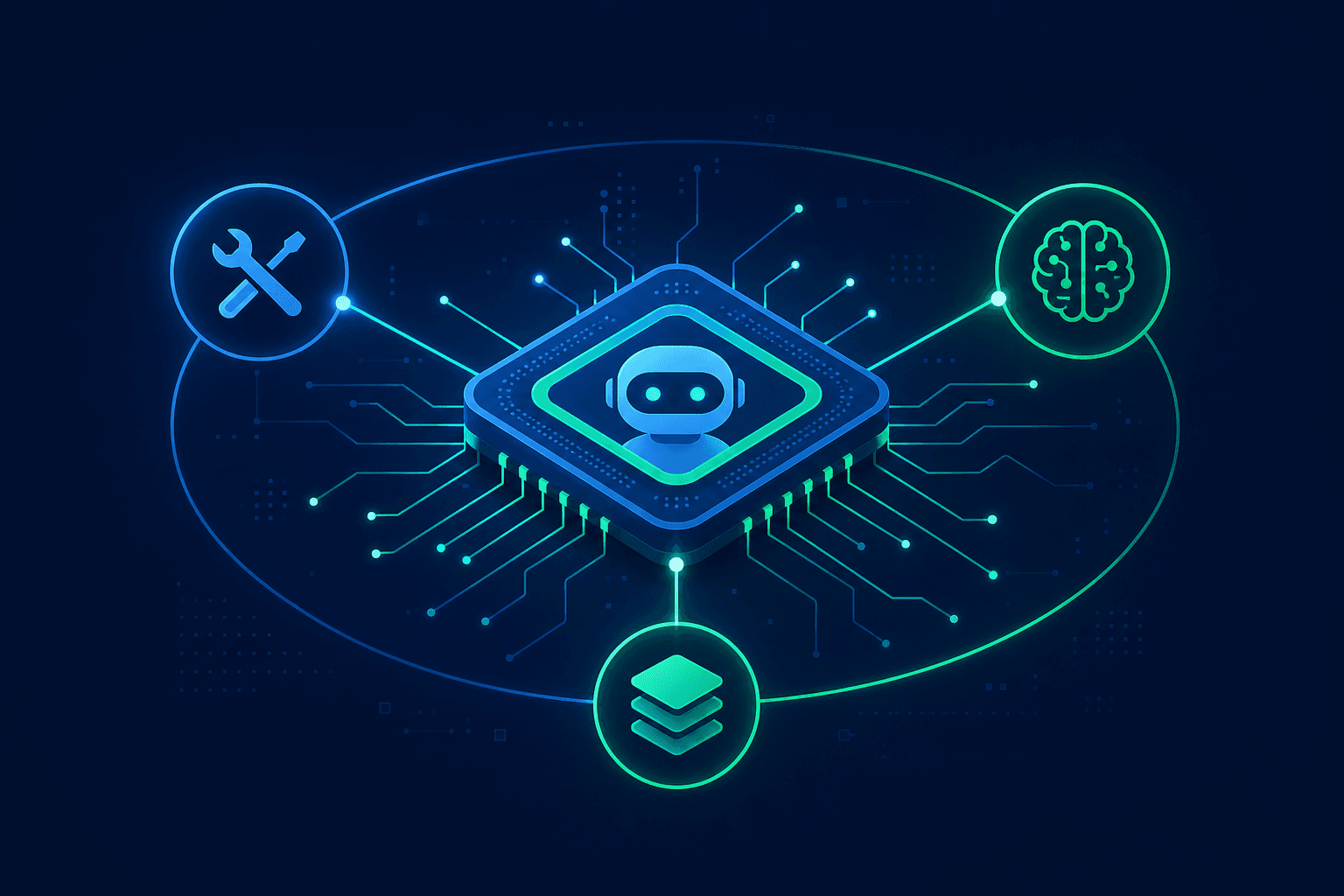
Because I just got admitted to study Computer Science at Miva Open University, I’ve had to study the basics of computer science again. In a lecture, we were taught something we’ve all heard before:
“The CPU is the brain of the computer.”
Of course, this isn’t new. We learned it in primary school. We repeated it in secondary school. It almost feels too basic to think about seriously.
But because I’ve also been reading deeply about AI agents, that simple statement started to feel different.
It just wouldn’t leave my mind.
What if AI agents are not revolutionary in structure, but evolutionary in abstraction?
What if we’re simply rebuilding the computer — at a higher cognitive layer?
The CPU Is Not “Smart.” It Coordinates.
When we say the CPU is the brain, we don’t mean it is intelligent in the human sense.
What it actually does is:
- Fetches instructions
- Decodes them
- Decide what needs to run
- Schedules execution
- Coordinate between memory and storage
- Call the appropriate operations
It is simply a control system.
The CPU’s power lies not in performing every operation, but in deciding which operation runs, when, and in what order.
It is an orchestrator.
And this is where something clicked for me.
Now Look at Modern AI Agents
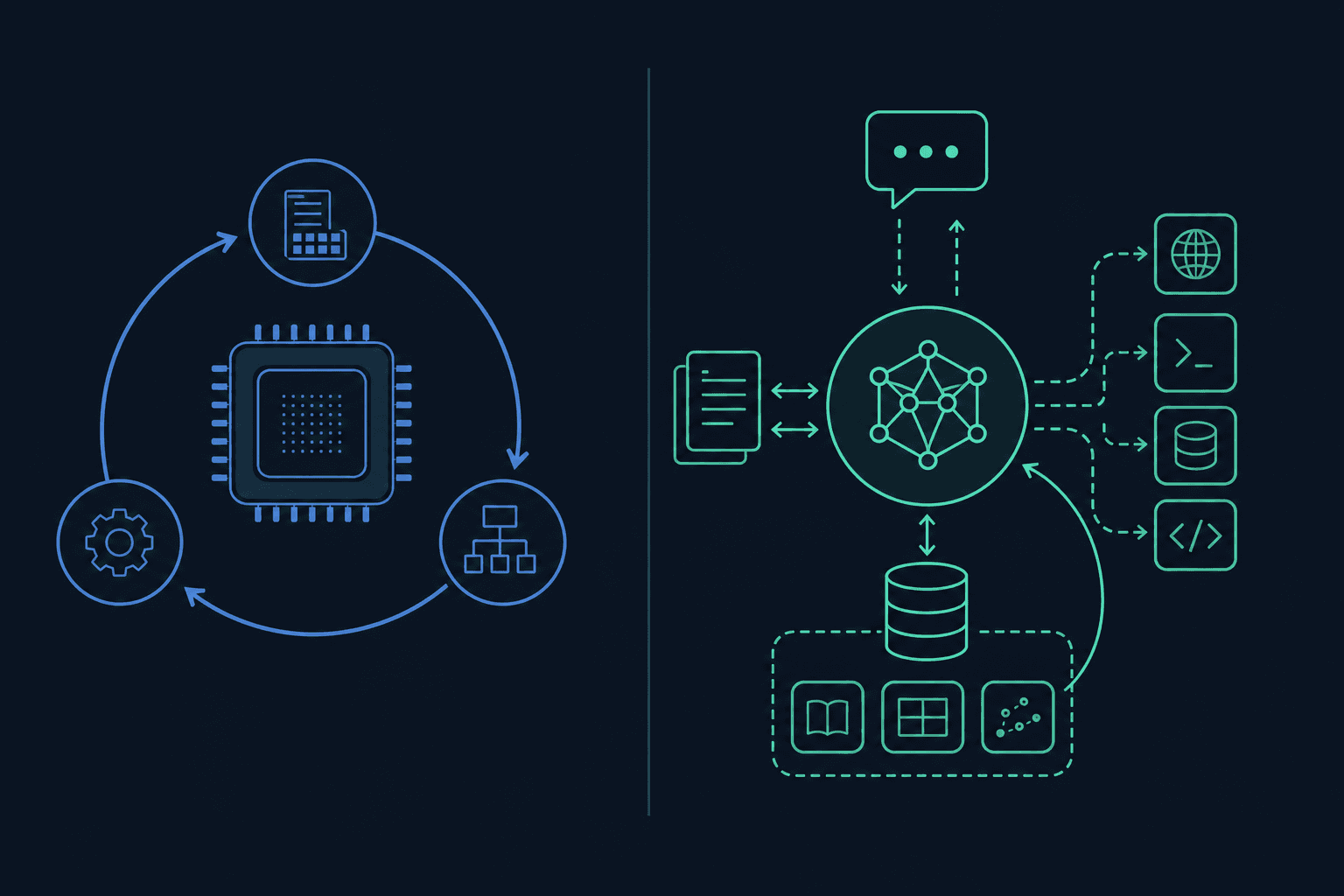
An AI agent built around an LLM behaves similarly.
At runtime, the system:
- Receives input
- Interprets intent
- Determines whether reasoning alone is sufficient
- Decides whether to call a tool
- Selects which tool to call
- Incorporates external retrieval (RAG) if necessary
- Integrates results
- Produces output
The LLM is not doing everything by itself either.
It is coordinating execution across external capabilities.
Sound familiar?
Yes, just like the CPU.
Skills Feel Like Installing New Software
In another lecture, we were told there are two types of software on a computer: the system software and the application software.
An application software is installed by the user to perform a specific task or solve a specific problem, e.g. Microsoft Word, Spreadsheet, Design Tools, etc.
Most importantly, we were told that without application software, a computer would have just been an ordinary electronic device that can only do basic operations.
In some AI agent frameworks, you can extend capabilities by defining new skills, sometimes as simple as a structured markdown file.
When I saw that, I couldn’t help but think:
Isn’t this similar to installing new software on a computer?
A computer becomes more powerful when you install applications.
An AI agent becomes more capable when you add skills.
Same pattern, but just a different abstraction layer.
RAG Looks Like External Memory
Then there’s RAG, Retrieval-Augmented Generation, which adds another layer to this parallel.
Instead of relying only on what’s inside the model’s parameters, the RAG system:
- Searches external knowledge bases (long-term memory?)
- Retrieves relevant information
- Inject it into the context window (working memory?)
- Uses it to reason
That feels a lot like what we’re used to in a traditional computer:
- Fetching from disk
- Loading into memory (RAM)
- Then executing
Again, the same architectural principle.
Tool-Calling Feels Like System Calls
In classical operating systems:
- User applications do not directly control hardware.
- They invoke system calls.
- The OS mediates execution.
In agent architectures:
- The model does not directly execute code.
- It emits a structured tool call.
- The orchestration layer executes the function.
- The result is fed back into context.
This means we have recreated system calls, but now the caller is a probabilistic model instead of a deterministic user application.
So, this isn’t magic?
Is the LLM Becoming a Software-Level CPU?
Now, this is the thought that keeps forming in my mind:
Within an agent system, the LLM functions like a software-level CPU.
Not hardware, but a high-level control plane; because:
- It does not execute arithmetic directly.
- It does not access memory directly.
- It does not perform input/output operations directly.
Instead:
- It decides.
- It sequences.
- It orchestrates.
That sounds familiar.
And, in that sense, we are witnessing the emergence of a new abstraction layer:
From:
- Hardware CPU controlling instructions
To:
- Software model controlling capabilities
The locus of control has shifted upward, from silicon to probability distributions.
Why This Matters (At Least To Me)
Revisiting foundational Computer Science concepts while watching AI evolve has been humbling for me.
It reminds me that every technological leap feels magical at first. But when you understand the foundations deeply, new technologies stop looking magical.
You start seeing patterns. And once you see patterns, you can build better systems.
I don’t have this fully formed yet. But I know this much:
The more I study first principles, the more AI makes sense.
And that’s a good place to be.
References
-
Patterson, D. A., & Hennessy, J. L. Computer Organization and Design: The Hardware/Software Interface.
-
Lewis, P., et al. (2020). Retrieval-Augmented Generation for Knowledge-Intensive NLP Tasks.